Mexico City and Beyond

It was unfortunate that I couldn’t but I feel that I had visited that city 11 year ago and was able to see and study a lot of art. Though I could only stay with the program briefly this year, it was a very positive experience.

One of the highlights was a your of the Anthropological Museum with artist, Eduardo Abaroa. Eduardo’s in depth knowledge of Mexican history made the visit to the museum all the more special and inspired me to think about some of the mythology we discussed as fuel for future works.

But the greater moment for me was my presentation and the reaction to the work I brought with me.

When I came to Transart, I did not know where and how I would fit in with the program and with the art world at large. I “just” did portraits in a world that seemed to reject any work that was not political or performative. “Make a video” was the Transart motto if all else failed and I even struggled with that.

By the Winter Residency of last year, however, the program found artist David Antonio Cruz as an adviser for me and that began to turn things around. In one studio visit, David inspired me to explore materials, size, juxtapositions (without ever asking me to stop painting portraits).

Then, in Berlin, Michael Bowdidge’s “Becoming Animal” classes inspired me to reveal a nine-year old self portrait I had done—exchanging my little-boy face with a goat face in order to subvert trauma I had experienced as a child. Additionally, Michael’s class inspire me to act out that trauma with fellow classmate Kate Hilliard that unlocked something I was afriad to look at.

As a result of David opening my mind, and Michael opening up my past, I was able to do work I had never thought capable of and the apex (so far) is the work I brought to Mexico City which are the reworked family photos I have been blogging about for the past few months.

The reaction in Mexico City to the presentation of the work and the work itself was overwhelmingly positive and it felt wonderful that my work was connecting in some subtle, haunting way with an audience of artists and curators. I felt like I had arrived at where I was supposed to with the program.

As we wrap up this final year of the program (with a process paper and a grad dialogue) I am beginning to think of what happens after Transart.

What’s next?

How do I continue?

How do I take what Transart gave me and keep that momentum going?

How do I continue to be, to become an artist?

thumbnail_IMG_8892.jpg

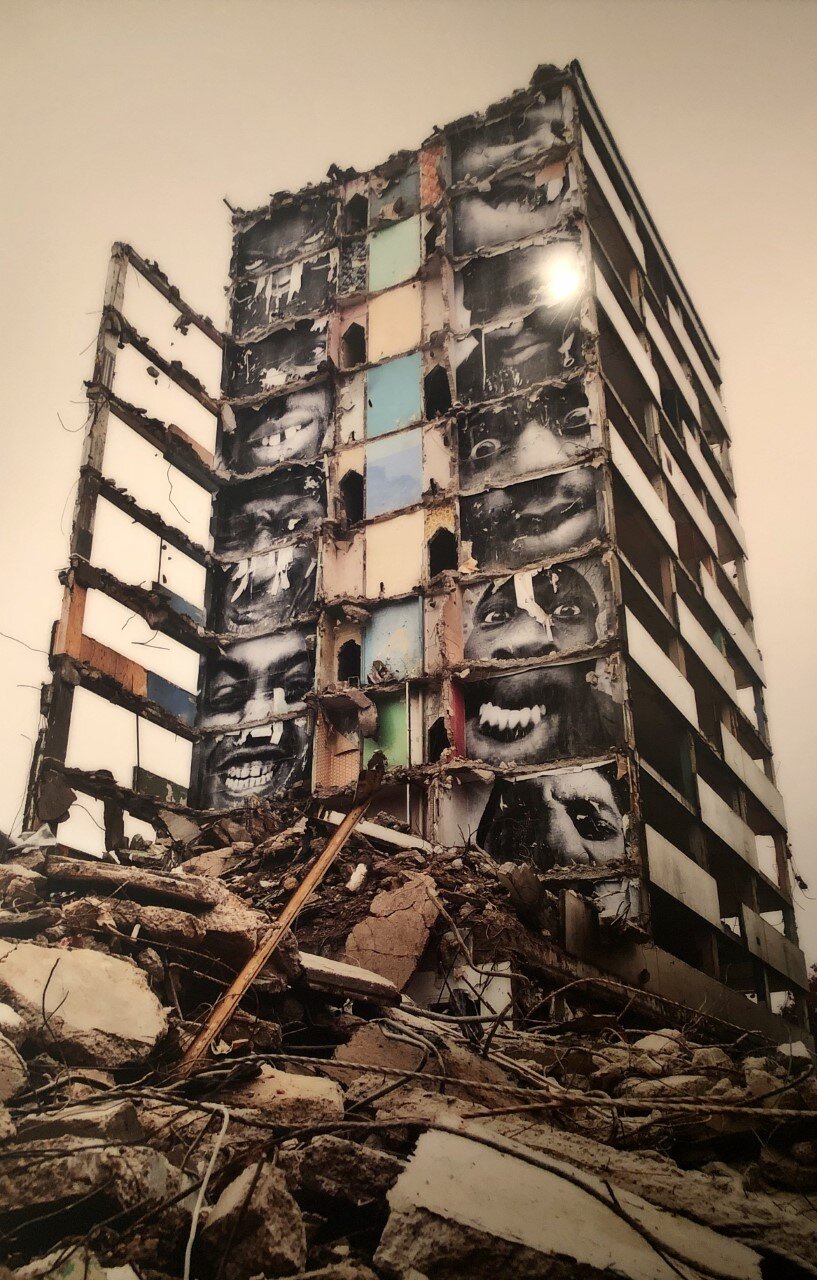
JR at the Brooklyn Museum

Yesterday, I went to see the JR exhibit at the Brooklyn Museum. JR is an artist from Paris, France who was originally a graffiti artist until he began taking pictures (with a camera he found on the Paris Metro) of he and his friends tagging all over the city. He posted enlarged copies of those photographs on walls across the city and framed them in spray paint. This evolved into JR taking close-up portraits of his friends who lived in the rough ghettos of France and posted enlarged images of their faces around the wealthier parts of Paris.

JR’s art moved from a personal place (images of he and his friends tagging up: a look at the lives of graffiti artists) to a more public issue (infiltrating white, bourgeoisie societies with Black and brown urban faces). Naturally I was moved by the portraiture aspect of JR’s work (portraiture is my passion) but as I moved through the exhibit, I found myself compelled to make art that works in and acts for public spaces.

I work in Harlem, New York: a neighborhood that is under attack by increased gentrification. Recently a young, white woman who had just arrived to New York and attended Columbia University (near/in Harlem) was stabbed to death in Morningside Park (a park just two blocks from where I teach young Black men and women high school English). The three suspects were all very young Black men. While news and headlines cried over the injustice of the murder of the young white girl, my primary concern was the young men I teach. The police had (have) not yet caught all three suspects. They are still on the hunt for two young Black men. And as we learned from the story of the Central Park Five, any young Black men will do in a pinch.

Inspired by JR’s work, I am planning my next project to be an intervention into Morningside Park. Portraits of young black men (small in size) strewn around the park with messages for anyone who will pick them up. I am still conceiving the project but I do know that I will collaborate with my students through the process.

JR.jpg
JR2.jpg
JR3.jpg

Personal Mythology

In my current project wherein I am reconstituting old childhood images (that project the memories of my mother, my sister, my step father, step brother, aunt, grandmother, and father) I am attempting to assign these images meaning as symbols of personal mythology.

According to Joseph Campbell, “myths are clues to the spiritual potentialities of human life. Myth is the experience of life and they teach you that you can turn inward” and there you begin to “get the message of the symbols”.

Campbell in The Power of Myth bemoans that we seem to have lost the importance of the old myths (the Greek myths, the Biblical myths, Native American stories, etc). He claims that kids today make their own myths as a result and “this is why we have graffiti all over the city”. While I am attracted to the idea of these marks as evidence of personal mythologies (like today’s Facebook pages where kids are creating their own mythologies through curated images and videos), I am more interested in the societal aspect of mythology that is lost; Campbell asserts that mythologies teach us how to “behave in a civilized world” and I contend that they also teach us about the world.

As such, it is my contention that popular and ancient mythologies pale in this job next to the mythologies of our childhood.

There is no substitute for learning about woman than your mother.

King Priam can not teach you the pain of loss the way a stepbrother may.

A serpent in the garden cannot teach you the concept of deception the way a boy who is trying to fuck your sister can.

In this vein, with this project, I am attempting to imagine my own childhood mythologies and the stories, the traumas, the lived lives, of those around me and how all of their ways of navigating the world impacted and shaped the way I live in the world.

As writer or recorder of my own mythology, I identify as the shaman versus the priest (as distinguished by Campbell).

“The difference between a priest and a shaman is that the priest is a functionary and the shaman is someone who has had an experience”. Further, “the person who has had a mystical experience knows that all the symbolic expressions of it are faulty”. This concept is important to my work. As I sit over the images and meditate, it is only when a symbol appears that blurs the experience that I begin working. It is very important that my mythology is not spelled out. “The symbols [should not] render the experience [but] suggest it”, according to Campbell.

If you haven’t had the experience, Campbell asserts, how can you know what it is?

thumbnail_IMG_7281.jpg

What's In a Number?

I have seven pieces.

Seven pieces that deal with memory.

Memory recast.

Reshaped.

Reconstituted.

An exploration of truth through symbols, through juxtaposition, through totems, through surrealism.

Seven is not enough, I feel.

There is more to be mined. More to be said. More truth to be explored.

But I am stuck.

The images are yielding no more than seven.

I will stare at the photographs some more tomorrow.

And then put them away.

And then stare some more.

Something will come.

And I will have eight.

memory 7.jpg

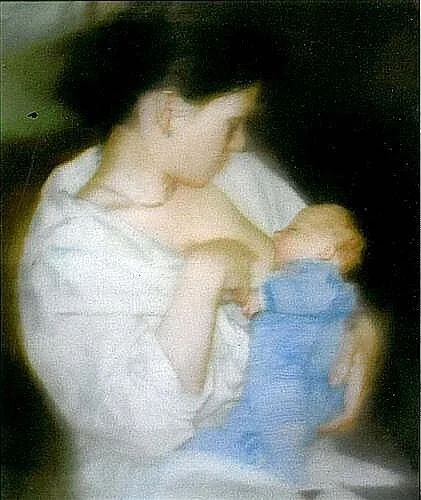
Gerhard Richter

The image here by Gerhard Richter reminds me a lot of how I am working with photographs in my project about memory. Richter’s process makes his photographs have a blurry quality to them. There seems to be a statement here of time or permanence. I am also attempting to discuss time and permanence but through image and memory and symbolism (perhaps a touch of surrealism). I am also very attracted to Richter’s sense of composition. His figurative works are neatly composed. But the neat composition combined with the blurring effect give his work dark undertones.

richter 4.jpg
The blurriness is in full effect in this piece and the monochromatic quality to it is reminding me of how I am working with paint for my  memory-project; before I begin each composition, I am laying down a foundation of gray and painting over it whi…

The blurriness is in full effect in this piece and the monochromatic quality to it is reminding me of how I am working with paint for my memory-project; before I begin each composition, I am laying down a foundation of gray and painting over it while the paint is still wet. I have to work a bit harder to work up the colors, the blacks and the whites in the pieces I am doing but it is giving those pieces the same monochromatic effect I am loving here in Richter’s work. Looking at this particular piece, it occurs to me that these works are about ghosts or about hauntings and I believe that the photographs from an old family album that I am choosing to treat in my paintings (or maybe, the photos that are choosing me) are about the things that haunt me: The specters that wander my subconscious.

This Black and white Richter image has me thinking about going deeper and further back into the family albums. Particularly the albums of my German mother and begin meditating on the images of her life before I was born to see what ghosts emerge.

This Black and white Richter image has me thinking about going deeper and further back into the family albums. Particularly the albums of my German mother and begin meditating on the images of her life before I was born to see what ghosts emerge.

Marlene Dumas

After seeing the direction of my latest group of paintings, my adviser, David Cruz, requested that I look at two artists who he said he sees similarities with in my work. They are Marlene Dumas from South Africa and German artist, Gerhard Richter. I took a look at the work of both artists online and chose three works for each that both caught my attention and works where I could also see a connection to my current work. Here I will present the three from Dumas that I studied. Next week I will address my Richter choices.

I was immediately attracted to this piece primarily, I believe, because it is a portrait. But the style is also very much like the style in which I am using paint for this series. The paint is applied thinly and there is also aspects of the composit…

I was immediately attracted to this piece primarily, I believe, because it is a portrait. But the style is also very much like the style in which I am using paint for this series. The paint is applied thinly and there is also aspects of the composition (the hands, the collar) that are outlined. Elderly women also play a heavy role in my work right now because I am mining old photographs from an album and many of the pictures record the older German women from my childhood. In both my work and Dumas’ above portrait, the women have a witchy-quality to them which I find interesting because when my mother began telling me the story of her life one day, she began at the Bavarian mountains where she reported that it was rumored witches lived.

This work by Dumas attracts me because of the pairing of a human portrait with an animal’s head. Of late, I have been playing with self-portraits and goat heads and while I have abandoned that path, the new work does include a child with goat eyes, …

This work by Dumas attracts me because of the pairing of a human portrait with an animal’s head. Of late, I have been playing with self-portraits and goat heads and while I have abandoned that path, the new work does include a child with goat eyes, animals, and I am planning to replace the head of a subject with an animal’s head for one of the final pieces. Even before my work with goat heads, I have always been attracted to art that combines animal imagery with human anatomy. I believe this may have sparked from my childhood fascination with Disney and Warner Bros. cartoons.

This Dumas portrait has a dark quality. There seems to be something strange or off about the person presented here. There is also a strangeness and oddity to the vignettes that I am painting. There is something off about each scene that seeks to tou…

This Dumas portrait has a dark quality. There seems to be something strange or off about the person presented here. There is also a strangeness and oddity to the vignettes that I am painting. There is something off about each scene that seeks to touch the sensibility of the viewer in a way that disturbs but holds them. I see this quality in the above Dumas portrait. Again the quality of the paint is thin and outlines are prevalent.

Recent Works

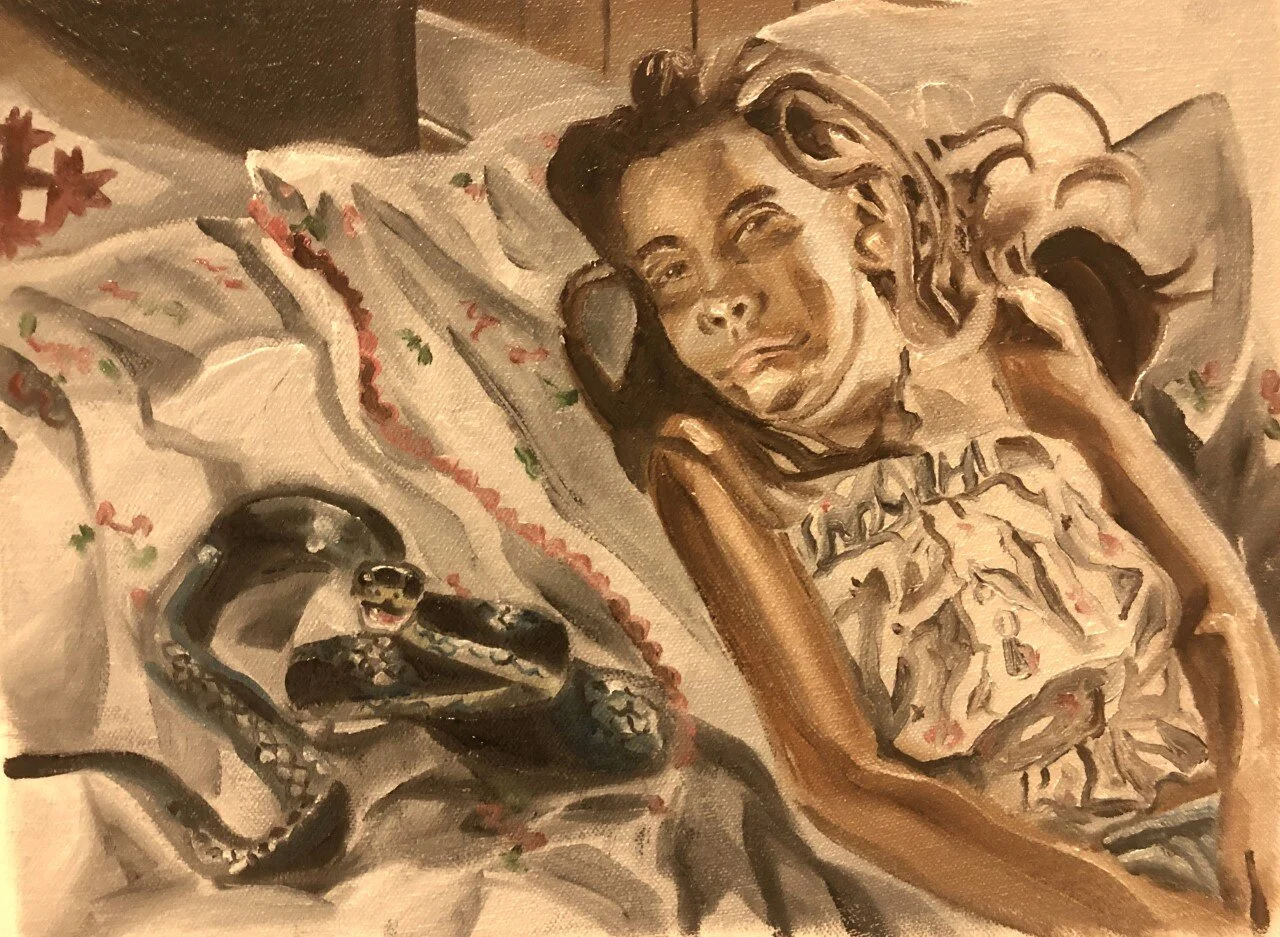
The process for this latest set of paintings is difficult but I am enjoying the challenge. The genesis was the goat painting: the painting I did of myself as a child on the beach: the painting where I could not get myself to paint my own face as a child so I painted the face of a goat (when thinking about the significance of the goat I must admit that there is no symbolism behind it. What happened that day that I was painting myself as a child was pretty much the same thing that happened in the origin story of the Hindu, elephant-headed god, Ganesha: One day the goddess Durga was bathing. She did not want to be disturbed so she created a guard for the door out of flakes of her skin. Durga’s husband arrived and, having been stopped at the door by this guard, the god of the Himalaya, Shiva, blasted the guard’s head off. Durga was distraught—the guard was like a son to her, created by her. In a panic, Shiva ran out to replace the head of the guard. The first creature he came across was a baby elephant and that is how the elephant-headed god of India was created…and that is how my goat-child was created. Unable to paint my own face as a child because of trauma, I looked around and the first thing I saw was a painting I had done of a goat’s head while in India).

I had decided that if I was going to explore the trauma, and the idea of memory, the best place to begin was an old family photo album. I chose some old family photos (many with myself as a baby or a child) to use, to change, to reconstitute. Sometimes i could clearly see how I would alter the photographs in an oil painting rendering of them. Sometimes I would have to lay the photographs out and stare at them, walk away from them. I always tried not to go with my first impulse in how I would alter the work. I had to think about it, walk around with the idea, let it percolate to measure if it felt honest or contrived.

The memory and the truth I am exploring revolve around many themes: sin, inheritance, Aryan culture, sex, race, parenthood, marriage, abuse.

memory4.jpg
memory2.jpg
memory1.jpg
memory6.jpg
memory5.jpg
thumbnail_IMG_5988.jpg

Painting and Sensation

What are paintings supposed to do in 2019? How do they function? How does work on a canvas compete with installation art that moves and transmits, performance art that has at its center a moving or a screeching or a silent body?

I think we look to visual (painting on canvas) art to give us the same sensations as installation and performance and I think very few painters have come as close to doing this is Francis Bacon.

In Deleuze’s meditation on Bacon’s work titled, The Logic of Sensation, Deleuze explores many facets of Bacon’s paintings that prove Bacon is tapping into sensation. One only has to see a Bacon (the distorted figure, the semi-circular grounding of flat color—often orange or pink—the screaming pope encased, the meat and the bones on the crucifix) to recognize this.

I feel that I do not have this capacity (to tap into sensation) or, at least, it is not inherent in the portrait work that I do. Or, if it is, I am unaware of it. My work, I feel, is directly related to stories. When someone looks at one of my portraits, I believe the physicality of the subject (the dress, the skin, the pose, the furniture) should tell the subject’s story or the story of the sitting—which, itself, is often ripe with psychological Easter eggs.

But I have no clue what the reception of my portraits is to the viewer. Do they touch sensation and I am unaware of this? Do they, in some way convey the story of the person or the session?

The tricky part also, for me, can be expressed in a quote from Deleuze that suggests these two things are counter intuitive: “Sensation is that which is transmitted directly and avoids the detour and boredom of conveying a story” (32).

This art of avoiding boring people with the work is part of the work I think we are all doing as artists: how do we create work that speaks to people without shouting at them?

For instance, I had conceptualized an idea of painting the portraits of white people living in Harlem (gentrifiers) in their homes and titling the work with their addresses. When I was talking to a friend who is not an artist, he suggested the same message (or sensation) could be better accomplished with painting a white person standing below the Apollo theater. I tried to convey to my interlocutor that this sounded boring: the message was being shouted at the viewer and it loses the opportunity for sensation. But my friend insisted that this was the better way to go.

I am starting to understand that sensation (and story) are best conveyed through a trusting of one’s instincts and through a spirit of experimentation and balancing one’s work between the story and the sensation.

Currently, I am appropriating the archives of my family album and working strictly with sensation to tell stories or to tell truth. I do not want to speak to much about he project because i do not want to fall into the trap of producing work that is flat and boring. The work speaks to family, family roles, inheritance, history, memory, truth, and mythology.

thumbnail_IMG_5988.jpg

Autonomy and the Archive in America

Currently, I have found my way into a project. The project is still in development. I did not quite understand what I was doing (I am using old family photos in the project). I was given an article to read titled “Autonomy and the Archive in America” by Lauri Firstenberg and some ideas from that article are helping me contextualize what it is I am doing. These are the lines I pulled from that article that best express my current project.

The idea of “unearthing narratives in historical archives” (313).

The idea of “min[ing the archives] for visual material and conceptual strategies” (313).

The concept that the photograph is an “unmediated and objective recording process” coupled with the idea that, in this project, I am looking to mediate the recording process of the photograph and make it subjective (313).

“The photograph functions as a sociological text, as evidence” (of what?) (313).

The archive as an “instrument of engineered spectacle” (314).

The concept of my creating a re-reading of the archive by “self-framing, reobjectification, self-staging, refetishization, and reversal” (314).

A bit lost

I am at a point where I am a bit lost in the work. I know that portraiture is where it is at for me but I cannot seem to articulate exactly what it is in portraiture that does it for me. I am uninterested in exploring many of the themes that advisors have hinted to me I should be looking at with portraiture like time and the relationship between sitter and artist.

I have tried going another way by exploring the image of the goat which has shown up in my work but that gels like a dead end to me.

So I am a bit stuck. I feel like I can’t move forward and just painting portraits feels a bit like moving backwards or just standing still.

I don’t think this is necessarily a bad place to be. I am marinating in something. I just do not know what.

Black Phillip

The Witch

In 2015, Robert Eggers released a movie titled, “The Witch” wherein an English settler family in America in 1603 live at the edge of the forest and begin to accuse each other of communing with Satan and witchery. While traditionally not regarded as a familiar for witches, the poster for the movie and the vehicle of accusations in the movie is a goat named, Black Phillip.

The Child

As a child, things were happening to me that I did not understand. I believed everyone knew it was happening. I still do. Because of the nature of the things that were happening, I stayed silent. But I acted out violently and erratically. I was threatened by mt mother and stepfather that if I continued the behavior and did not ell them why I was behaving in that way, they would send me to an asylum. I was more afraid to be sent away than of what was happening. I promised to behave.

The Goat Child

In 2015, I painted myself as a child using an old photograph as reference. I could not paint my face so I painted the face of a goat instead. I could not paint the face of the child I silenced. I silenced him to save him. I didn’t know the damage I was doing to him. To me.

Mother

In 2016, my mother feared she was dying as a result of a brain aneurysm To get her mind off of it, I asked her to write out her life story. She opened by writing that she was born in a village at the foot of the Bavarian mountains and, she wrote, the Bavarian mountains was rumored to house witches.

Satan in the Forest

For a very very long time, I believed that the acts of my stepbrother turned me gay. I had communed with something I was not supposed to and I liked it. I had thought God had turned from me and damned me for it. I had thought my stepbrother was a test I had failed. I was eight.

Sister

A few years ago, I visited my sister. We sat on her porch at night talking. She told me she blamed herself. We were not talking about what happened. We never did. We just mentioned his name and something was summoned between us. I told her that she was not to blame; I told her she was a child too. We stopped talking and stared into the black night of Florida swamp.

1014170_10201476604937388_2130987066_n.jpg

Scapegoating

In family therapy, the concept of scapegoating has a similar origin, and potentially a similar effect, both for the family and the scapegoat.

Typically, the family will target, though not intentionally, at least not at first, one member of the family to become the focus or cause of all of the problems of the family. The result for the family is a means of deflecting attention from the real conflict. The real conflict that spawns this act of scapegoating can be anything, for example, alcoholism, chronic illness, marital discontent. The family will feel relief, but the scapegoat will feel angry and alone. The goal of the family is not to deal with and resolve the issues, but, rather, to cover them up. This effect, though seemingly ben- eficial, is actually an unfortunate outcome of this targeting. It does not absolve the family of their contributions to the dysfunction. Rather, it exacerbates the dysfunction and can have serious consequences for the scapegoat.

-Lori Ellison. Marshall University.

goat.jpg

After Berlin: Year 2

For the summer residency in Berlin this past August, I showed to projects I had been working on. Both projects were portrait-based but instituted juxtapositions into my work. Both  projects had a philosophy behind them because I had come to believe that art needs a philosophical backbone in order to make it relevant. Just yesterday, I was applying for an exhibition grant and, while reviewing successful past proposals on the exhibition grant’s site, I read proposals discussing displaced peoples as a result of climate change, proposals dealing with transgender awareness in Brazil, and proposals dealing with preserving The art of African Americans who live in the South. By the wording, it was easy to tell that the artists were neither displaced peoples, transgendered, or, themselves necessarily African American. Yet they adopted these issues and created projects around them.

This is the type of work I brought to Berlin:

A project using Greek pottery image to “elevate the portraiture of black and Latino gay males whose stories and paradigms get lost in gay culture dominated by gay white males”. 

And a project of drag queen portraits using comic book design to make a point about “how diluted cultural phenomena become when it is rustled into pop culture earning large companies millions of dollars”.

My reviewers in Berlin were Jean-Ulrick Desert and Nathalie Bikoro

Both reviewers had the same message for me:

The philosophy must come from inside. “I don’t see you in the work”, was their lament. The art, they insisted, should be about the artist. I am still wrestling with a direction to go in as a result of this feedback. 

Transart is an institute that demands a change of direction in your practice—experimentation outside your comfort zone. 

Yet, ironically, the two reviewers agreed that the strongest pieces I showed that afternoon were the two basic, no-frills, no-gimmicks, no philosophy, portraits I showed at the beginning of my presentation to show the reviewers my starting point: the type of work I was doing before joining Transart Institute. 

Reading Diary: Editing Spaces (Benjamin Busch and Lorenzo Sandoval)

Georges Perecs’ taxonomy of space in Species of Spaces got me thinking about the spaces I have occupied and/or the spaces I have witnessed.

In America we have separate spaces for Black people and for white people. It is not the era of Jim Crow. It doesn’t have to be. This is America.

The Ghetto

I grew up in one of the Black spaces of New York City called Lefrak City. I listened to R&B music and was present for the birth of hip hop. The faces that occupied the spaces around me were Black faces. There were Black matriarchs and Black men. There was Black people’s food: fried chicken and mac and cheese (these are not myths nor stereotypes—they are cuisine that came up North from the South during the Great Migration—which—in itself—was a change of spaces—but I digress). The people in this space, my childhood space, who were in charge, who called the shots, were Black people. I occupied an internal space of Black power and control within a larger space of white dominance. It was like an illusion whose idyllic nature I did not realize until I was older and learned what the space of America truly was.

The Attic

In 1984, Jesse Jackson ran for President of the United States. I knew the history of Black Americans. In Lefrak City I had a front seat to and was given lessons on the continued oppression of Black people. I imagined, at 13 years old, that if Jesse Jackson won, myself and my family would occupy a small space in some Black family’s home (like Anne Frank in the attack) once Jesse Jackson had the power to obliterate the white oppressor and bring justice to his people. We had many Black friends so I knew we would be okay once the assault began; we would travel from apartment to apartment and live in closets, kept safe by the Black folk who we grew up with, who patted me on the head, fed me from their spoons, and whose children I played with in the streets.

The Girlfriend

In 2016, I met a Black woman who wanted to marry me and have my child. The space she occupied was a world apart even if we sat or lay side by side. White women were nurturing and friendly to me. They liked me. I made them laugh. White women were her sworn enemy and, at every turn, were planning her destruction. I, unwittingly, unknowingly, and insensitively occupied a space of privilege and she occupied a space two spaces below that privilege—being both Black and female. She threw things at me, very often, from below. She wanted my child hoping the baby would inherit my skin color and my hair texture; she wanted to ensure that her baby did not occupy her space but, rather, could readily slide into my space.

The Classroom

I work in a high school in Harlem New York (a space in NYC that is being invaded via gentrification). My classroom is big. It is decorated with rugs and a growing collection of framed pictures of former students. The walls record the history of the children (a portrait of Malcolm X, a framed newspaper front page of Obama’s victory). There are plants and there is artwork created by myself and students. The space is designed for the Black students I serve. I pick up the garbage in that space. I have seen other classrooms; balls of paper litter the floor, paper hangs ripped off the walls, stacks of student work lay abandoned in piles on the teacher’s desk. Some classrooms are bare—as though the rapture long ago pulled up all he goo students and all the good teachers. These spaces are not meant to teach Black children. These spaces are designed (garbage and papers or empty walls) to say, “YOU DON’T MATTER”.

The Chokehold

Last week in America, the Justice Department announced that it would not press charges on Officer Panteleo, the white cop who killed a Black man who was allegedly selling loose cigarettes. The first portion of the explanation as to why no charges were being held was a citing of the size of Mr. Eric Garner versus the size of Panteleo. Eric Garner occupied much much more space. He was a big Black man. A Black man in America is not allowed to occupy so much space: so much height and width—it is imposing to small white men. The Justice Department then transitioned into the hold; according to them, Panteleo only meant to subdue Garner by encircling the space around Garner’s neck. Garner’s size and the space around the two then colluded to turn a subduing gesture into a chokehold as the space between the cop’s forearm and Mr. Garner’s neck dramatically decreased as the two fell and collided with a store window behind them. Most importantly, the Justice Department cited that all eleven times Mr. Garner screamed, “I can’t breathe”, the space around him was clear—no officer was touching him at that point.

This is America.

Reading Diary: Magic Materiality (Susan Poetz)

While reading Dario Novellino’s “sensory view of how magic works”, I could not help but think about my own experience with teaching.

I teach high school English and I have always thought it was a sort of magic.

I am a successful teacher. I am “that” teacher: the one who all the students love for all the right reasons and the one who all the other teachers are not crazy about. I am also a blight on my principal because he (being the empirically-grounded man that he is) cannot bottle my efficacy at teaching.

And that is because my teaching practice is, in Novellino’s definition of the term—magic.

Firstly, Novellino cites Tambiah’s “primary concern” of magic as being “the transferring of a desirable property to a recipient lacking that property” (756). To be very specific, I am an English teacher and most people believe that High School English usually constitutes the transfer of two main properties: reading and writing. I believe that High School English constitutes the properties of thinking and writing (reading, in my own practice, is an ancillary skill used for attaining knowledge in order to further the more important skill of thinking).

So the highest level property I want to transfer is thinking. How do you teach people to think? To employ logic? To draw conclusions? To synthesize information and produce, from this synthesis, new thought? To my colleagues and my principal’s dismay, there is no graphic organizer for this level of skill; there is no outline. If students are tasked (as they are in my classes) to develop a unique strain of thought in their writing (I do not want to read 30 of the same essays), they most know how to think and in the public school system of New York City, I have found that no one has ever asked this of them before me.

My magic begins with talismans all around my classroom: Framed photographs of intellectuals who resemble the students I serve from President Obama to Malcolm X to Toni Morrison. There are objects I have collected around the world that are explained to the students: A statue of Ganesh, the elephant-headed god of Hinduism, is explained as the “remover of obstacles”. These things, as Novellino points out, are not mere decorations to make my classroom homey but they serve to change and to charge the environment, to “impregnate” the environment in order to “produce an effect” (760). They work, I believe on the subconscious of the students on many levels. Not just symbolic. If we want to explain this as simplistically as possible, the environment is one of physical caring—it is a thoughtful environment. In their other rooms, mass-produced Department of Education posters hang sideways off of walls full of old tape and chart paper is hung with instructions or rules scrawled by a teachers careless hand with a dried out marker. Or the rooms are barren with only balled up paper littering the floor. Part of my practice is also the maintenance of the room. Litter on the floor changes the physical environment and is scooped up, by me—the shaman—once it hits the floor.

More than the physical environment is the actual act of teaching which seems more attuned with Novellino’s ideas. Novellino attempts to dissolve the distinction between the “expressive and the technical”, between the “mystical and empirical” (762). Such is how I teach thinking and writing. Much to my principal’s dismay, the way I teach thinking and writing cannot be categorized neatly into rubric traits to be checked off on a chart or checklist. In short, I describe the magic (that unique thought I am asking for, the logic, the synthesis, the invention) I am looking for, I give examples of that magic by demonstrating my own trains of thought and arrivals at logical and unique conclusions, and then—in the same way the Batak believe that bees and rice get released from the “edge of the universe” (758), I insist to my students that their own unique and insightful theses and conclusions get released from somewhere in their minds and I challenge them to call it forth.

Even Novellino’s section on action and sound resonated. When I have my students write, I will usually sit and write with them. I have been known to call students’ attention to watch me, to watch my body and my face as I am writing because I want them to see the thinking process—to see me stopping and staring intently into space (into the edge of the universe) trying to find what I am looking for, to see my hands gesticulating as though I am pulling that thing from the air, or asking the universe a question. Soon, I see my students using this dance to also call forth ideas, answers, direction, and conclusions.

When I talk about how difficult my teaching job is, I have always described it as “trying to pull my own mind from my head and showing the students how it gets from a question to an insightful and unique answer. It is like trying to transfer the way my mind works to their own minds”. But it is more in line with Novellino’s idea of magic. I know that teaching thinking is possible because I know that that “edge of the universe” in my own mind, where my theses derive from, where they live awaiting to be called upon, is also a located in their undeveloped minds and I only have to call upon words and rituals to reach it. My methods have varying degrees of success. Very few students learn the magic for themselves. It is difficult to correct 11 years of miseducation. But many of them leave me at least aware that they have the ability to manipulate their consciousness and they are also aware that the answers lay somewhere inside of them and not simply on a page to be underlined and repeated or copied.

My methods are exactly the opposite of how most public school systems operate; they operate on the empirical alone and if you cannot disseminate your methods via a PowerPoint presentation and if you cannot record the levels of student success on a spreadsheet, you have not done anything. People usually attempt to separate my classroom, my methods of communication, my bearing, my humor, my neatness, my patience from my practice but I sand by Novellino’s ideas of the power of “impregnation” and “attunement “ through the use of words, actions, and objects to produce a desired effect.

Reading Diary: Becoming Animal (Michael Bowdidge)

In Gerald L. Bruns’ “Becoming-Animal”, the author describes this becoming as being formed of an “in betweeness” (714), as an ability to become “imperceptible”(712), to be “nomadic” and “restless”(704) and it is linked, in his writings to a loss of the face which “becomes a mask without any relation of representation” (711). My response to the reading threatens to be (at best) both off-the-mark and a simplification to the ideas presented. At worst, my thoughts threaten to sound self-hating and intolerant.

I had always known that I was gay as a child. I had clear desires for the fathers of childhood friends and male television and movie stars. But like many young gay men, I attempted—for a long time—the straight and narrow; I dated girls and then young ladies. I had intercourse with them and devised futures with them appropriate for a young man growing up in a NYC ghetto in the 1980’s. I carried and I wore the face that “allow[ed] me to pass into human society” (Bruns 712).

At 20 years of age, I met a man. His name was Giovanni (of course). We became fast friends and then, in his car one rainy night, we became more: I became something else.

In 1976, Anne Rice wrote a gothic novel titled, Interview with The Vampire. In the story, a vampire named Lestat seduces a man named Louis and transforms Lois into a vampire. The gay community received this novel as an allegory to the recruitment-nature of homosexuality: a gay man meets a man who (like me) has an underlying nature that he wants hidden or that he is not yet prepared to deal with; the gay man befriends the other, seduces him, and then releases that hidden nature thus further “peopling” the gay community.

Becoming-animal, according to Bruns, “involves a peopling”(705). It is about “contagion” (705).

When I met Giovanni, I was, i believed, very happy with my girlfriend of 5 years. We were going to marry and have children. She was warm and loving and exceedingly smart. The sex was great. I knew that I had other yearnings that “arrive[d] and pass[ed] at the edge, teeming, seething, swelling” and I had considered it a personal triumph having never given into “this nameless horror” (Bruns 705).

I want to be clear that the horror, the becoming-animalistic-nature of “becoming gay” was not just psychological which is why the article moved me to write this.

One night as Giovanni drove me through the city, we rode past The Monster Bar—a gay bar located just opposite New York City’s landmark Stonewall Inn. Giovanni pointed it out. Seeing the curiosity on my young face, he informed me that I was not ready for that: “They would eat you alive”, he warned.

A year later, venturing in, I met the “pack”, the “band”, the “population” (705) of men who had also become.

In the 80’s and the 90’s, these places (the bars and clubs) were still secretive and each man inside still lived a double-life of some sort—be it to his family, his friends, his wife, or his job. I learned that gay people were legion: not some random man sitting in his parked car alone in the night but a “swarm” (705).

And the swarm was peopled with these inbetween creatures: in between man and woman. The swarm sloughed off gender-duality through their movements and gestures, or the way they spoke and laughed, or the way they dressed (on this night, in this place) or the subjects they spoke about. It was truly—it had to be—a metamorphosis because they could not speak, act, and dress that way before the world. The affectation was to much. It was not real. The myth to me was that in these dark places, gay men could allow their true nature to show. But it seemed to me that the personas I saw and interacted with were just as unreal as the ones these men most-likely shared at work and at their family’s home during holidays.

According to Bruns, “the becoming-animal of the human being is real, even if the animal the human becomes is not” (706).

At 47, being a gay male feels dull and normal. The things I do now, I would do if I were with a woman: no difference in how I act, dress, or the things I pursue in life. Who I am is not calcified by what I have become and gay culture at large has a minimum affect on my existence. But what was “real”, what shook me, what shakes me always, was my becoming.

MCP504 Part B: Proposal

Recently through discussions with my advisers, I have become curious about juxtapositions: worlds colliding: worlds created from that collision. 

To conduct this collision effectively, you have to be intimate with both worlds.

But I think that too much intimacy: too much knowledge restricts the work or the world you’re trying to create. My aim is to juxtapose the art of comic book illustration with the art of gender-bending in drag and trans performance.

I know the genre of superhero comic art very well, particularly the work of Canadian comic artist, John Byrne, whose work on the X-men in the late 70’s fuels the movie franchises we see in theaters today.

I know drag performance as much or as little as anyone who is a part of queer culture. Well, maybe slightly more; I am very good friends with a trans-performer and am acquainted with several other drag performers in NYC.

These are two entertainment genres that have interested me and I wondered how they would work together.

I could easily conceive the visual: drag performer painted portraits overlay on top of comic book backgrounds—perhaps clumsily so—or maybe fully integrated and interacting with the comic book background.

But all of this to what purpose?

The easy answer was to lionize drag and trans performers: I would research comic book pages that I wanted to replicate (say a splash page featuring Wonder Woman punching out a villain), then ask the drag performer to strike a similar pose, record the pose, and render both the comic background and the comic hero on a large scale but replacing the hero figure (Wonder Woman) with the drag or trans performer.

But this seemed too easy and too uninteresting.

I wanted to say something with these portraits but at the same time, I did not want to say anything. I wanted to find the balance between the work having relevancy and sparking interest without the work being obvious and hit-you-over-the-head-progressive and preachy.

Without direction, I began to just peruse the internet for images: Splash pages by John Byrne (chosen because he was and is my favorite superhero comic artist of all time).

A splash page is the first page a reader opens up to in a comic book. It is the first image of an issue and it usually is used for exposition but also carries a high element of drama to pull the reader in. It is my belief that a comic book splash page offers the perfect stage for a project on drag and trans performers because it positions them into performance (the drama of the splash page) but offers room to subvert that drama through the text feature of the comic page.

My first objective in this project was to gather John Byrne splash pages that interested me aesthetically as well as dramatically (I tried not to “see” my drag subjects in them yet).

I found that I was drawn to splash pages where the hero was in some way bound: trapped under a building—struggling to hold it up, strapped to a machine for some experiment, floating unconscious: held in the air by an invisible force. These were the situations I found most interesting: perhaps because I wanted the work to explore the nature of drag and trans performers and people: I want maybe to test their strength (?). Maybe I thought it would be interesting to see these usually large personalities quiet and passive and up for inspection or struggling and under duress. Perhaps by putting them in a situation (either passive or active) that was not posed as on a stage I am trying to humanize them in a way. I’m not sure yet.

Once I got the images down, I had to think about text. Text was a must if I were to be true to the form of comic book art. But what would I replace with the copious squares and rectangles full of exposition that appear on a splash page? My first thought was replacing the exposition with something biographical about each subject but that seemed, right away, too passe.

After beating my brains to death, I decided the best course was to allow research to dictate the next move and (as the maxim of Transart suggests) allow myself to play.

So, I google searched articles on drag performance, articles on drag psychology, articles on trans versus drag and I perused whatever came up searching for anything that would match the images I found (heroes bound or under duress).

This is perhaps the most interesting part of the project: I am attempting to find articles that seek to bind or put drag and trans performers under duress but I am eliminating articles that are, somehow, too much. I am allowing in ignorant voices, but only when I believe one can find the humor and naivete in the ignorance. I am finding voices that challenge and inform or seek to inform but sound ridiculous in its attempts at authority.

I have to start thinking about material (I am thinking of large un-stretched canvas) and acrylic. I have to start arranging sittings of the drag performers I will use. I have to think about the text feature (free hand or stencils). I am anxious to begin. Below are the answers to any questions that may have escaped the above description.

Working Title of Project: Translations of Perception

Suggested Advisors: David Antonio Cruz and I have just begun to work together and it is fruitful so I would like to stay with him. Jean Marie, of course, is a treasure and I’d hate to lose her but it may be interesting to work with a trans-artist. I am wondering if Transart has one in residence, can find one, or would be interested in working with one of the trans-artists who I know or who I am acquainted with.

Description of Project Report: I feel this time around that I would like to attempt a project report over a thesis paper. It would include my process which I would synthesize with my own growing understanding of drag and trans lives through research that would coincide with my work. The work itself explores the ignorance of how we have diagnosed, how we perceive, even some clumsy ways of how we accept drag performers and trans people. I would balance that work with research on drag performance and trans lives and report on the contrasts or even any intersections between the ignorance and the researched realities.

Project Results: I have in mind a series of 10 pieces where I am juxtaposing portraits of drag or trans performers onto comic book splash pages. The first iteration may be actual illustrations of the compositions on the 11X17 bristol board comic artists traditionally worked with using non-reproducing blue pencil and finished with India ink. The final versions may be large un-stretched canvases done with acrylics.

Initial Bibliography:

Trans bodies, Trans selves. Edited by Laura Erickson-Schroth

God and the Transgender. Debate by Andrew T Walker

The Changing Room. Sex, Drag and Theater. by Laurence Senelick

Why Drag? by Magnus Hastings

Various opinion articles and blog entries on transgender people and drag performance.

Abstract of Written Element: Why are we so fascinated by drag and gender bending? I ask: are we fascinated with gender bending as a whole phenomenon (male to female/ female to male) or are we fascinated with men who dress, act, and some who actually become women?

It seems to be the latter. Male to female impersonation and transformation appears more prolific, more covered in media and entertainment, and more outrageous. 

Male to women drag or transformation is performance and therefore more fascinating. One might argue that female to male is also performance (one might argue all gender is performance) but male to female performance , for some reason, seems to lend itself to buffoonery. I have never seen a drag show that contained a line up of female to male trans or drag performers pretending to mimic old Hollywood stars or contemporary male divas. I have never seen female drag performers or trans men on a stage exaggerating the movements and the vocalizations of men in over-the-top caricatures of men’s costumes (suits?)(jeans and T-shirt’s?). Why aren’t  lesbian bars filled on Friday and Saturday nights with trans-men lip-syncing to Justin Bieber or Bruno Mars?

Could it be that women just do not have that entertainment instinct as strongly as men do? Or are they not brave enough to make a fool of themselves onstage? Have we oppressed women so much over the ages that they fear the awkwardness of transformation and self deprecation? Are women afraid to make fun of men and the way we move, speak, dress, coif because of the patriarchal structure that still attempts to control their reproductive rights?

Or are men—as subject matter— just...boring?

I submit that drag and trans performance is a result of men’s (both gay and straight) fascination with the complexity of what it is to be a woman. In addition, I submit that we watch drag and trans performance out of fascination of that fascination: We are watching men enact our own fascination with what it is to be a woman.

But fascination without education can lead to ignorance, clumsy attempts at being an ally, and, in some cases where that fascination is repressed—violence (or a violence of words, or a violence of diagnoses). This projects puts that ignorance and violence on display in order to provoke questions and promote conversation.

Timeline for Realization of Project: The initial Bristol board pieces will begin in June for the first two to three weeks. I am hoping to have 2-3 canvases done by the time I arrive to Berlin in August.


jb1.jpg
jb7.jpg
jb8.jpg
jb11.jpg
jb2.jpg
jb13.jpg
jb14.jpg

Copy of MCP504 Part A: Synthesis

01-Write a concise description of your studio project

Like most first year Transart students, after summer residency I was lost in the woods in terms of just what the hell I was going to do next. The Berlin residency put my previous work into perspective but did not offer a clear path into anything else because that first year residency seemed to lead into everywhere else: performance, film, assemblage, an exploration of materials. The artists I was meeting during the summer residency in Berlin were philosophers. They were people who were interested in material, memory, silence, and juxtapositions.

I paint portraits. I love painting portraits.

But clearly, just painting portraits wasn’t going to cut it anymore. So, I decided I needed a philosophy behind my portraits: I chose the philosophy of truth—of capturing moments of truth in a portrait through the use of video. My process involved setting up the space for a traditional portrait of someone while videotaping the sitting. The idea was that, as I engaged in conversation while making the portrait, the video camera was capturing vulnerable moments in the conversation (a confession, a reaction, a revelation, a loaded silence) that more truly revealed the subject more than the working portrait would; What I was attempting to capture were MICROEXPRESSIONS (TRUTH or LEAKS) on film and translating those into “true” portraits: According to American psychologist, Paul Akman, “when single emotions occur and there is no reason for them to be modified or concealed, expressions typically last between 0.5 to 4 seconds and involve the entire face. We call these macroexpressions; they occur whenever we are alone or with family and close friends. Macroexpressions are relatively easy to see if one knows what to look for. Microexpressions, however, are expressions that go on and off the face in a fraction of a second, sometimes as fast as 1/30 of a second. They are so fast that if you blink you would miss them”. Ekman goes on to report that “microexpressions are likely signs of concealed emotions”. I practiced my method of trying to capture these microexpressions twice (reviewing the footage, looking and listening for that vulnerable, true moment, freezing the frame and then painting that image) and brought the results of those two experiments to the Winter Residency here in New York.

It was here that I met David Antonio Cruz who was to be my new studio adviser.

In response to my presentation on truth portraits, David suggested that truth can never truly be captured—that we are always performing when in front of other people and he even suggested that I was performing right there in that Brooklyn studio space with this presentation.

He was correct. I was floundering. I was looking for a philosophy not for philosophy’s sake but for anything that allowed me to simply keep doing what I wanted to do: paint portraits.

Soon after this presentation, David, visited my studio, looked around and gave me a list of directives:

Explore a different material

Think of space, think of tone, think of patterns

Continue working with what you like (bodies)

Experiment: think of collage: create worlds

Use the things in your studio, the items you have hanging up and displayed

In giving these directives, David used a word that had been repeated several times during the Berlin residency: play.

So I abandoned the quest for a philosophical backbone, looked around my studio, chose a different material and began to play.

I knew that David was right in telling me not to loose what I love which was portraits so that would remain the center of my work. But how, I wondered, could I engage with portraiture and create worlds?

One of the patterns that repeated itself in my studio was coming from items I brought home from my trips to Greece: replicas of urns, plates, and statues that told the stories of ancient gods and heroes in tones of black paint on orange clay all bordered in ornate bands across the edges.

Many of the stories depicted on these urns were tragedies: the eating of children, the defeat of an enemy, the fall of a hero, the judgment of a god. And so I began to choose subjects for portraits who had a tragic element to their stories—at least the stories of those subjects that I knew.

At first, I was choosing people from my past and present using only this criteria: a connection to tragedy.

I soon realized that my tragic subjects had something else in common: they were all gay men of color.

A philosophy began to emerge. But I ignored it. I committed myself to play in the creation of this world. I spent my days perusing the internet for images of ancient Greek pottery, collecting images of Greek borders, Greek deities, animals, avatars, and soldiers that would match the elements of the tragic stories of my chosen subjects:

One of my subjects (Kevin) was a victim of tragic hyper-sexualization and so was paired with satyrs.

Another subject (Jose) was a victim of tragic hubris and so was paired with Zues in the guise of a swan.

A victim of tragic illness (Chris) was paired with the lion skin worn by Hercules.

A victim of tragic madness (Tito) was paired with sirens floating around his head.

The result is a ten piece collection of what I call “Homeric portraits”: black and orange depictions of gay men of color juxtaposed with elements from Greek pottery and accented by ornate borders and concise text around the figures painted using acrylics on unprimed wood panels of different sizes with the final piece (a transgendered man) painted on an actual ceramic planter.

The stories told shape the tragic aspect of gay life and gay culture, specifically for gay men of color. But they also serve to elevate these men and their tragedies to the heights of epic poetry.


02-How did the research impact upon your project and your working practice?

My research paper attempted to answer two questions:

1.What is the impact on Black subjects when they are depicted by non-Black artists?

2.If there does seem to be a negative impact across the board of non-Black artists using the Black image (no matter how accidental, no matter how unintentional, no matter how good-intentioned and socially conscious), should non-Black artists use the Black figure in their work at all? Is America still too neck-deep in white-on-Black racism that boundaries must exist in how white people use or appropriate the Black figure for personal gain?

While I (unfortunately) was able to cite many instances in which white artists were charged with transgressing racial sensitivities and these transgressions were backed by institutions and curators, I found solace in the works and the criticism of the work of Alice Neel who, by living among her subjects in Spanish Harlem, and painting them as neighbors rather than subjects, served to humanize them rather than objectify them. I left my paper with a feeling of kinship far closer to Neel than to artists who I identified as transgressors like Mapplethorpe and Dana Schutz. I was able to move to my Homeric portraits and the tragedy behind my Black and brown subjects because I knew them or know them well enough to already know their tragedies. They are people in my life. Not subjects for my use.

Though my use of Black and Latinx subjects for the Homeric portraits was incidental rather than a direct result of my research—the fact that it was incidental pillars my conclusion about the use of Black and brown figures in art; my subjects came from my life, my surroundings, my friends, my lovers. The people I used, I was intimate with enough that I could cast them in my Greek-inspired portraits because I knew them well enough to know their intimate tragedies and character foibles. As such, while to the world at large, I am depicting people of color, I am, in actuality simply depicting the people in my life.

I did not, though, want to abandon “the mission”.

“The mission”, as stated in my paper, was to join Kerry James Marshall (and a host of other artists) who depict only people of color as a statement against the idea that figuration in art is dead (and comfortably laying in a cemetery populated by white people).

The Homeric portraits revealed tragedies in the lives of Black and Latinx gay men but they also elevated those tragedies to epic proportions by placing men of color alongside gods and heroes. So, as I give myself a Neel-esque pass to continue to “use” people of color in my work, I will keep in mind that another part of the Marshall plan (the Kehinde Wiley part) is depicting Black and Latinx subjects in states of elevation, veneration, and/or with a great deal of humanity.

As a side note, David is directing me towards fine-tuning my technique which, I believe, is in alignment with my ideas about elevation, veneration, and humanity; if I am looking to be sure that my subjects are received in a way that elevates or humanizes them, the work should look as though it took more time and thought (and work) than what it currently is showing: particularly the rendering of the figures and the precision of the Greek borders in the Homeric-portrait series.

03-What directions does your project suggest for further research?

I am and will probably be for a long time interested in people—in types. Part of my interest has always been with people of color because of my surroundings and because of the twisted history of my country. Another type that has interested me has been drag and transgender performers. In this I am not alone. Hollywood news online reporter The Deadline reports that last season’s viewership of RuPaul’s “DragRace” hit over 700,000 viewers. Caitlyn Jenner was overwhelmingly embraced after her transformation. And last year, trans actor, Laverne Cox made history as Cosmopolitan magazine’s first transgender cover girl. With this new-found celebrity and seeming acceptance, my interest moves from the stories of these performers (it is the performers I am looking into) and more towards our fascination and thoughts on gender-bending people. By gender-bending, transforming, performing these transformations, these drag and trans people are, themselves, creating worlds. More interesting is looking at how we (non-trans, non-drag folk) are receiving, questioning, diagnosing, narrating these worlds—trying desperately to make sense of it all past the entertainment value of it. I have written up a proposal for a project involving the idea of created worlds and our collective concept of what it means to be drag and trans that looks deeper, I think, into the outsider and his viewpoint and less into the subject of interest thus reversing my usual getting-to-know-my-subject way of working and moving into something akin to a playful yet poignant aggressive-objectification to see what I can shake out of this tree—something that will promote thought and conversation about this other sect of our society who fascinate and inspire me.
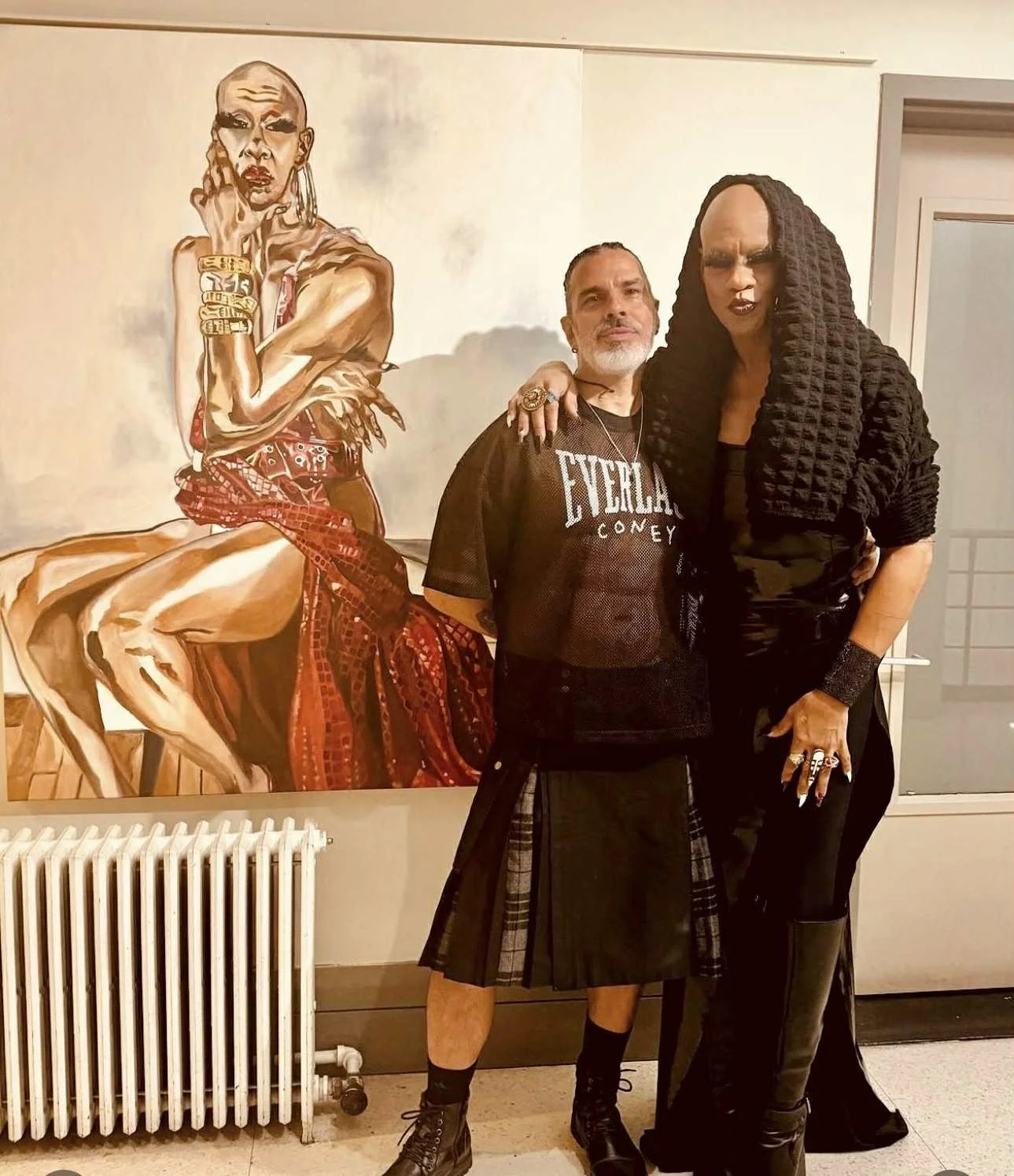
Kevin with Satyrs: He Ordered Love. He Was Brought to Sex.

Kevin with Satyrs: He Ordered Love. He Was Brought to Sex.

Jose as Leda: He Believed that God Especially Loved Him: He Also Believed that Obama Was Sending Him Emails.

Jose as Leda: He Believed that God Especially Loved Him: He Also Believed that Obama Was Sending Him Emails.

Lorenzo as Eronemos: He Put Out a Plate of Dry Cat Food at a Party and All The Boys Loved Him.

Lorenzo as Eronemos: He Put Out a Plate of Dry Cat Food at a Party and All The Boys Loved Him.

Kent with Warrior-Spirits: He Blamed Us All For Not Being Sick Too. It Was a Valid Complaint.

Kent with Warrior-Spirits: He Blamed Us All For Not Being Sick Too. It Was a Valid Complaint.

Andrew Impaled: Anger Made Him Believe Cutting Off His Hair Would Rid Him of Negative Energy Only to Find The Bad Energy Was In His Head Not On His Head.

Andrew Impaled: Anger Made Him Believe Cutting Off His Hair Would Rid Him of Negative Energy Only to Find The Bad Energy Was In His Head Not On His Head.

Tito With Sirens: He once Broke the Leg of a Puppy.

Tito With Sirens: He once Broke the Leg of a Puppy.

Giovanni With Penises: He Hated Things About Himself, He Was Dyslexic. He Was Adopted. He was Gay.

Giovanni With Penises: He Hated Things About Himself, He Was Dyslexic. He Was Adopted. He was Gay.

Carlos in Battle: He Knew That All He Had To Do Was Wear a Cap and Put His Hand on His Dick While Standing in the Corner and He Was Guaranteed Company. he Hated It.

Carlos in Battle: He Knew That All He Had To Do Was Wear a Cap and Put His Hand on His Dick While Standing in the Corner and He Was Guaranteed Company. he Hated It.

Chris in Hercules Lion Skin.

Chris in Hercules Lion Skin.